E-House Substation Ventilation and Cooling
Packaging an e-house substation, ventilating a utility control house, or cooling an oil and gas MCC or VFD building? We handle it.
We match fans, louvers, dampers, heaters and cooling units to your building size, heat load, voltage and area classification.
We select the equipment from about 30 manufacturer lines, quote it, and return a selection ready for submittal.
Our offices are in Houston and Dallas-Fort Worth, serving Texas and the Gulf Coast, and we ship nationwide.
Not sure which fan, louver or cooling unit fits your e-house?
We match the equipment to your heat load, voltage and site.
Key Takeaways
E-House Ventilation Equipment We Supply
Each row is equipment we supply for e-houses, substation control houses, and MCC and VFD buildings.
| Equipment | Where it goes | Standard or rating |
|---|---|---|
| Wall exhaust fans | End wall, exhausts gear heat | AMCA 210, UL 705 |
| Utility set fans | Filtered supply and pressurization | AMCA 210, UL 705 |
| Explosion-proof fans | Buildings at classified sites | AMCA spark resistant Type A, B or C |
| Fixed louvers | Outside air intake | AMCA 500-L |
| Drainable louvers | Intake in heavy rain areas | AMCA 500-L |
| Control dampers | Behind intake louvers | AMCA 500-D |
| Backdraft dampers | Exhaust fan openings | AMCA 500-D |
| Unit heaters | Winter heat, keeps gear dry | UL listed |
| Explosion-proof heaters | Heat at classified sites | Class I, Division 1 and 2, gas group by model |

What Is E-House Ventilation Used For?
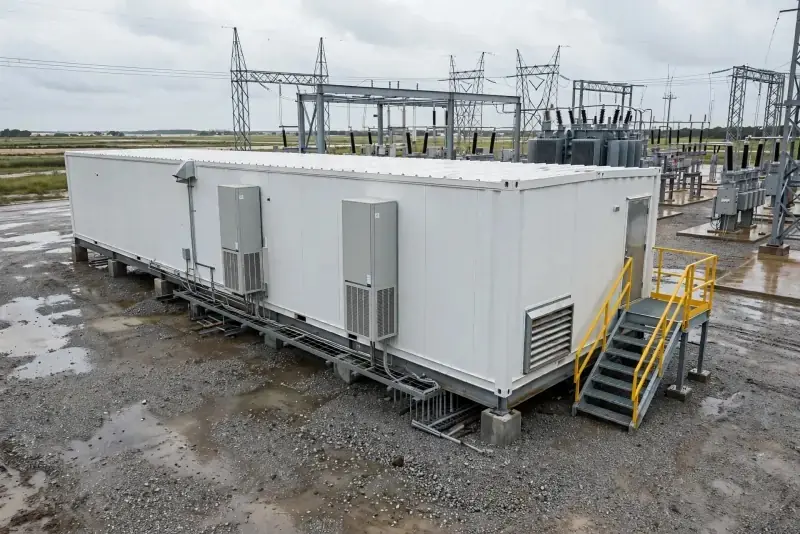
E-house ventilation is the set of exhaust fans, intake louvers, dampers, heaters and cooling units that keeps a prefabricated electrical house within its gear’s temperature rating.
Most switchgear, motor control centers and drives are rated for a 40°C (104°F) ambient, the limit used in UL 845 and IEEE C37.20.2.
Ventilation removes the heat the gear gives off, about 2 to 3 percent of a variable frequency drive’s load. Outdoor air holds the room only a few degrees above the outside temperature.
Where Gulf Coast summer highs in the mid-90s °F leave too little margin, cooling units take over. Heaters keep condensation off the gear in cold, humid weather.
Common Questions
What fan does an e-house at a hazardous site need?
An e-house fan at a hazardous site needs AMCA spark-resistant construction and a motor rated for the area, such as Class I, Division 1 or 2. All three types apply when flammable gas is in the airstream. Type A makes every airstream part nonferrous. Type B uses a nonferrous wheel and shaft ring.
Can an MCC or VFD building be cooled without air conditioning?
An MCC or VFD building can be cooled without air conditioning when the gear may run warmer than the outdoor air. Closed-loop heat exchangers, rated 17 to 200 W/°F per unit, use no compressor and no refrigerant. Thermosiphon units also skip the compressor. Where the room must stay below the outdoor peak, use a wall-mount air conditioner.
What louvers does an e-house need on the Gulf Coast?
An e-house on the Gulf Coast takes drainable louvers tested to AMCA 500-L for airflow and water penetration. On the Texas coast, specify louvers with a TDI windstorm product evaluation. Florida's High Velocity Hurricane Zone needs a Miami-Dade approval. Fixed louvers come in 2 to 6 inch blade depths with 35 to 60 percent free area.
Building or retrofitting an e-house, MCC building or control house?
We match the ventilation and cooling to your gear's heat load and your site.
E-House and Control House Ventilation
E-house and substation control house ventilation removes the heat that switchgear and drives give off. We supply wall exhaust fans, intake louvers with control dampers, and utility set fans that keep the building at a slight positive pressure so dust stays out.
At oil and gas sites classified under API RP 500 or RP 505, we supply explosion-proof fans in AMCA spark-resistant Type A, B or C. We also supply explosion-proof heaters for Class I, Division 1 and 2, with the gas group set by model.
Cooling MCC Buildings, VFD Buildings and Control Houses
MCC buildings, VFD buildings and substation control houses are unmanned, so cooling only has to protect the drives, relays and switchgear. We supply four types of wall-mounted cooling units, from units with no compressor to full air conditioners.
Closed-Loop Heat Exchangers
A closed-loop heat exchanger cools the room through a sealed core, with no compressor and no refrigerant. The unit fits dusty or humid sites where the gear may run warmer than outdoors, but cannot cool below the outdoor temperature.
Thermosiphon Heat Exchangers
A thermosiphon heat exchanger carries heat outside with a sealed working fluid and no compressor, and two fans are its only moving parts. The unit fits 48 VDC sites, but cannot cool below the outdoor temperature.
Wall-Mount Air Conditioners and Heat Pumps
A wall-mount air conditioner or heat pump holds the room below the outdoor temperature. The unit fits drives that must stay cool through the summer peak, and one controller runs up to eight units in lead and lag.
Economizer Backup Units
An economizer backup unit starts its fan when the air conditioner shuts down and pulls cooler outside air through the building. The unit is a backup only, because it brings outside air in.
| Unit | Capacity | Power | Enclosure and rating | Outside air |
|---|---|---|---|---|
| Closed-loop heat exchanger | 17 to 200 W/°F | 115 or 230 VAC, 460 VAC on the largest model, 24 or 48 VDC | UL 1995 tested, stainless optional | Sealed out |
| Thermosiphon heat exchanger | Varies by model | 48 VDC, 115 or 230 VAC | NEMA 3R, UL 1995 tested | Sealed out |
| Wall-mount air conditioner | 24,000 to 60,000 BTU/h (2 to 5 tons) | 208/230 VAC single phase, 208/230 or 480 VAC three phase | NEMA 3R and 4, AHRI 390-2021 | Sealed out |
| Economizer backup | Varies by model | 24 or 48 VDC, 115 or 230 VAC | Outdoor mount | Brings it in |
These cooling units are for buildings in unclassified locations.
Related E-House and Substation Equipment
- Oil and gas HVACProcess area ventilation and control room pressurization
- Oil and gas ventilation checklistStandards to check before a hazardous site submittal
- Generator room ventilationFans and louvers for standby generator buildings
- Miami-Dade louversHurricane rated intake for Gulf Coast buildings
- Acoustic louversLower fan noise at substations near homes
- Gastight shut-off dampersSeal intake and exhaust openings tight when closed
- Fiberglass dampersCorrosion resistant dampers for coastal and chemical sites
- Droplet separatorsRemove sea spray and salt at coastal air intakes