Acoustic Louvers
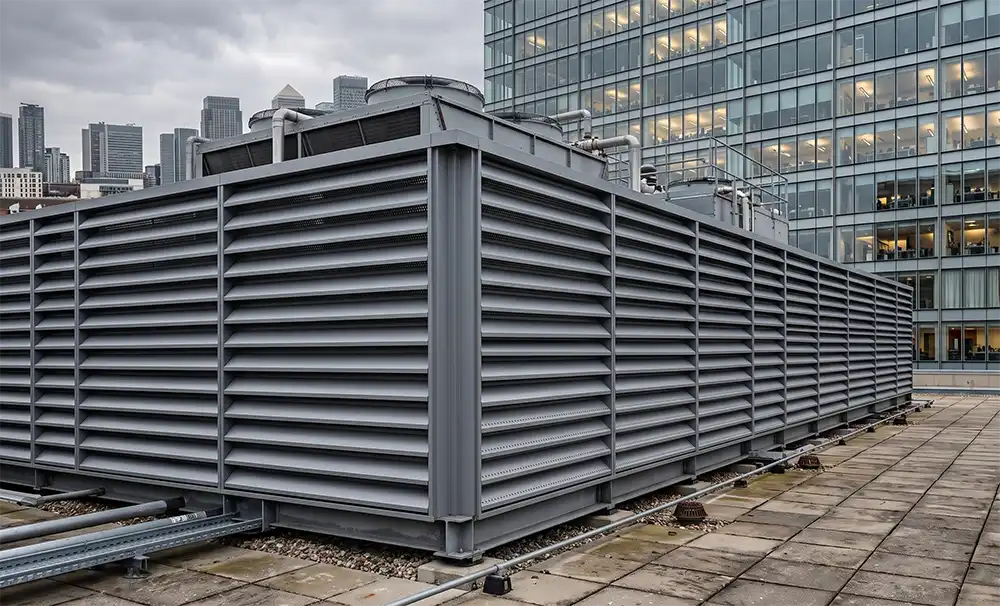
Acoustic louvers, also called acoustical louvers or sound attenuating louvers, move air through a wall opening while reducing the noise that passes with it. We supply depths from 4 to 12 inches. Tell us the opening size, airflow, and noise limit, and we match the louver to it.
We carry three louver lines and compare all three before we quote, so you get the one that meets your specification and ships soonest.
Our offices are in Houston and Dallas-Fort Worth, serving Texas and the Gulf Coast, and we ship nationwide.
Have questions? Need a fan quote?
Key Takeaways
What Changes the Sound Rating
Two things set the sound rating: frame depth and blade spacing. Depth alone does not decide it.
| Frame depth | Free area | STC | Pressure drop | Typical use |
|---|---|---|---|---|
| 4″ | 33.7 – 39% | — | 0.04 – 0.06 in w.g. | Shallow walls, curtain wall infill |
| 6″ | 25.0 – 28.1% | 12 | 0.06 – 0.078 in w.g. | Mechanical and chiller rooms |
| 8″ | 25.1 – 28% | 12 – 14 | 0.08 – 0.10 in w.g. | Packaged generator sets |
| 12″ | 14.9 – 34.6% | 10 – 21 | 0.06 – 0.13 in w.g. | Property-line noise limits |
*AMCA certified ratings available. Certification varies by model, size, and category: Air Performance, Water Penetration, Sound, and AMCA 540 impact. Send us your specification and we will confirm which models carry what you need.
Free area in the 12-inch row runs from 14.9 to 34.6 percent and STC from 10 to 21, all at the same depth.
Blade spacing, not depth, produces that spread.
Tighter spacing raises STC and lowers free area, so the opening grows to move the same air. An 8-inch louver on 6-inch spacing reaches STC 14 at 26.5 percent free area. A 12-inch louver reaches the same STC at 21.6 percent.
STC, Transmission Loss, and Noise Reduction
Three numbers describe how much noise a louver stops. Transmission loss is measured to ASTM E90 and reported by octave band. Free field noise reduction reports the same test differently. STC is one number from ASTM E413, useful for comparison and weak on low frequency.
Noise reduction is often quoted as transmission loss plus 6 dB. The gap is not always 6. These two louvers come from the same line:
| Depth and metric | 125 Hz | 250 Hz | 500 Hz | 1000 Hz | 2000 Hz | 4000 Hz |
|---|---|---|---|---|---|---|
| 4″, transmission loss | 2 | 2 | 4 | 8 | 9 | 7 |
| 4″, noise reduction | 11 | 10 | 12 | 17 | 18 | 17 |
| 6″, transmission loss | 5 | 5 | 7 | 10 | 12 | 11 |
| 6″, noise reduction | 11 | 11 | 13 | 16 | 18 | 17 |
The 4-inch gap runs 8 to 10 dB. The 6-inch gap is 6 dB at every frequency. Compare transmission loss to transmission loss. Do not mix the two.
Specifications by Depth
Every configuration below is published performance on a 48 by 48 inch test unit per AMCA 511.
Blade spacing is the column to read against STC. Where a water penetration figure carries an asterisk, it is a pressure drop velocity, not a tested beginning point of water penetration.
Tell us the depth you can fit and the STC you need, and we will name the models.
| Depth | Blade spacing | Blade style | Free area | Water penetration | Pressure drop | STC |
|---|---|---|---|---|---|---|
| 4″ | 4″ | 37° J-blade | 33.7% | 740 fpm | 0.06 in w.g. | — |
| 4″ | 4″ | Straight | 39% | 680 fpm | 0.04 in w.g. | — |
| 6″ | 6″ | 45° airfoil | 25.0% | 1,137 fpm | 0.06 in w.g. | — |
| 6″ | 6″ | 45° blade | 28.1% | 858 fpm | 0.078 in w.g. | 12 |
| 8″ | 6″ | 45° blade | 26.5% | 990 fpm* | 0.10 in w.g. | 14 |
| 8″ | 8″ | 45° blade | 25.1% | 956 fpm | 0.09 in w.g. | 12 |
| 8″ | 8″ | Box blade | 28% | 868 fpm | 0.08 in w.g. | — |
| 12″ | 9″ | 45° blade | 14.9% | 990 fpm* | 0.10 in w.g. | 21 |
| 12″ | 12″ | 45° blade | 21.6% | 1,089 fpm | 0.10 in w.g. | 14 |
| 12″ | 12″ | Airfoil | 21.8% | 1,127 fpm | 0.06 in w.g. | 13 |
| 12″ | 15″ | 45° blade | 34.6% | 1,173 fpm* | 0.13 in w.g. | 10 |
Related Products
Have questions? Need a fan quote?