Fiberglass Fixed Blade Louvers
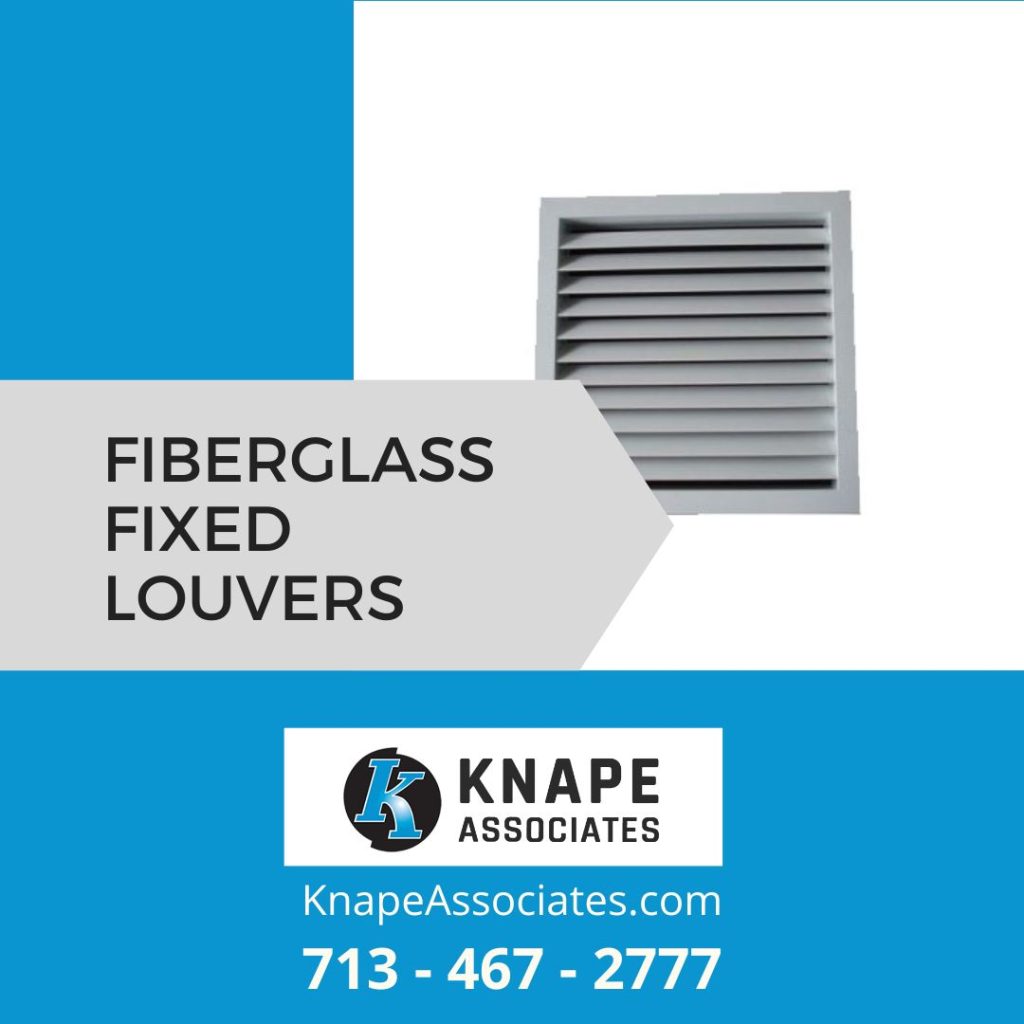
Fiberglass fixed blade louvers protect air intake and exhaust openings in corrosive environments. Blades are typically 6″ deep with a drainable design that channels water to the sides and discharges it at the sill.
Knape Associates supplies FRP louvers in 4″ and 6″ configurations, sized to your free area requirement. Send us your CFM and opening size and we will confirm the model.
Have questions? Need a quote?
Key Takeaways
Fiberglass Louver Specifications
Free area velocity at the beginning point of water penetration is the number that sizes the louver. Higher velocity means more airflow through a smaller opening, at the cost of earlier water intrusion in a storm.
| Blade depth | Blade angle | Free area | Water penetration velocity | Pressure loss |
|---|---|---|---|---|
| 4″ | 45°, ~4.5″ on center | 37.6% (6.0 ft² at 48″ x 48″) | 730 FPM | 0.08″ W.G. |
| 6″ | 35°, ~3.875″ on center | Consult factory for exact free area | 1,239 FPM | Consult factory |
Minimum louver size is 12″ x 12″. Standard construction goes up to 72″ x 72″ per section, with unlimited width and height in multiple-section assemblies. All ratings are per AMCA Standard 500-L, tested on a 48″ x 48″ specimen.
How to Size a Fiberglass Louver
Divide your required CFM by the free area velocity to get the required free area in square feet. Then pick the louver size whose free area meets or exceeds that number.
For intake applications, check the beginning point of water penetration first. If that velocity is lower than your calculated free area velocity, size to the water penetration number instead, not the CFM number. Exhaust applications size to CFM only.
The tested velocity is a lab number, measured in still air. Most engineers derate it 15 to 25 percent to account for wind-driven rain on site. Screens change the free area too: a bird screen adds about 5 percent to pressure drop, and an insect screen adds closer to 18 percent. Account for the screen before finalizing the size.
Construction and Resin
Resin choice decides how long the louver lasts. Two systems cover industrial louver work, and the difference matters more than the blade profile.
| Service condition | Resin | Why |
|---|---|---|
| Outdoor intake, UV exposure | Isophthalic polyester | Standard grade, good weathering when UV-stabilized |
| Caustics, dilute acids, continuous wet | Isophthalic polyester | Holds up in sustained wet and alkaline service |
| Wastewater, H&sub2;S, odor control | Vinyl ester | Resists sustained sulfide exposure |
| Acid scrubber and fume exhaust | Vinyl ester | Higher acid resistance than polyester |
| Wet chlorine gas | Vinyl ester | Request ASTM C581 immersion data for your concentration |
| Coastal salt air | Isophthalic polyester | Vinyl ester if the louver takes direct spray |
The surface veil does the chemical work, not the bulk resin. A resin-rich synthetic or C-glass veil is the first barrier, and a louver with the right resin but a poor veil degrades from the surface in.
| Item | Specification |
|---|---|
| Glass content | 48% minimum by weight |
| Flame spread | Class I, 25 or less per ASTM E-84 |
| Surface veil | Synthetic or C-glass, resin-rich |
| Temperature | To 200°F |
| Bird screen | 1/2″ mesh, PVC-coated or 316 stainless. Adds about 5% pressure drop |
| Insect screen | Finer mesh. Adds about 18% pressure drop |
Custom FRP Fabrication
Catalog FRP louvers stop at 72″ x 72″ per section. When your opening does not fit a standard size, or the blade pattern you need is only published in aluminum, we have the louver built to match.
Send the opening dimensions, the free area you need, and the chemical exposure.
We work with fiberglass fabricators to produce the section in FRP, in the resin your process calls for. Multiple-section assemblies cover openings of any width and height.
Related Products
- Fixed Louvers — aluminum and galvanized options when the environment is not corrosive
- Fiberglass FRP Dampers — airflow control behind the louver
- Fiberglass Control Dampers — volume control and isolation in the same corrosive duct run
- FRP Fans — corrosion-resistant air movement for the full exhaust path
- Droplet Separators — moisture removal ahead of downstream equipment