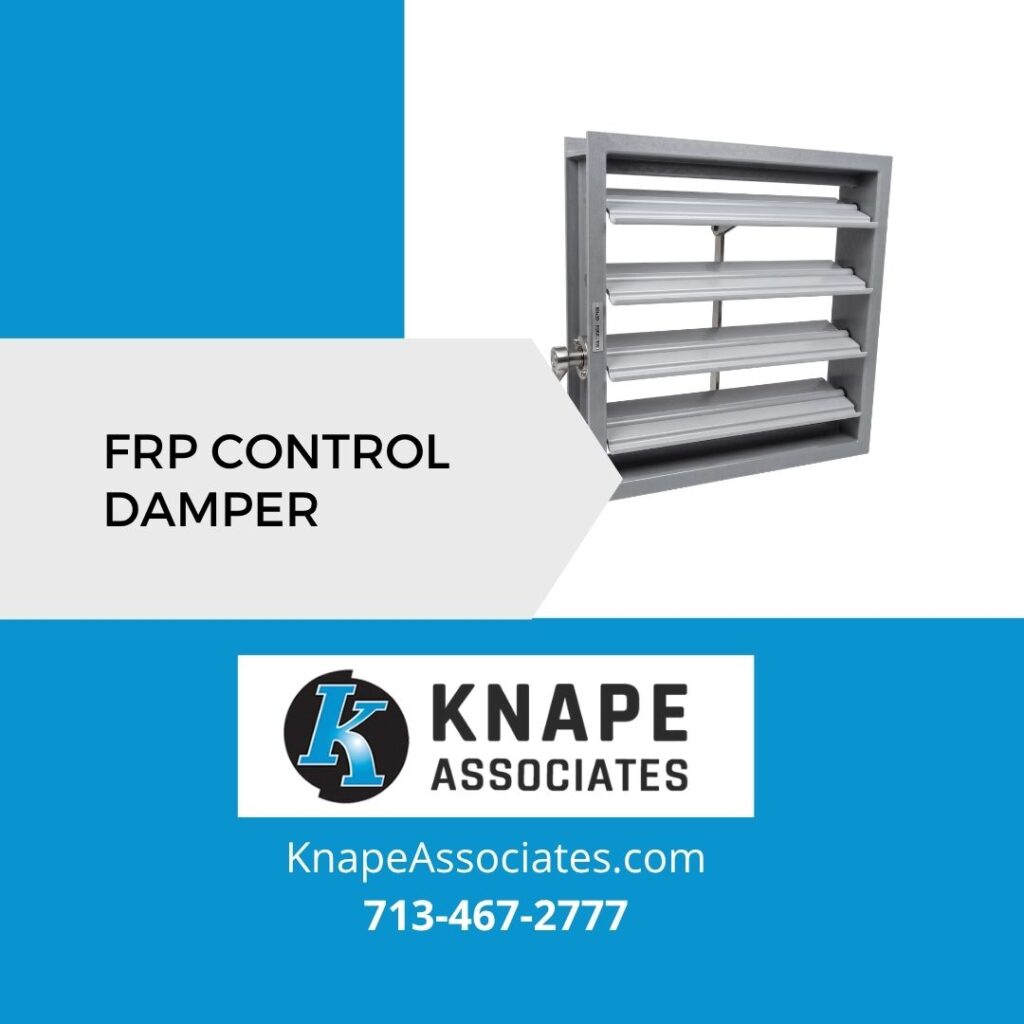
Fiberglass Control Dampers
Fiberglass control dampers regulate airflow in ducts and fan systems where corrosive fumes destroy metal. Knape Associates supplies FRP control dampers in center-pivoted, opposed blade, parallel blade, and round configurations.
Send us your airflow, duct size, and chemical exposure. We will confirm the right model and size.
Have questions? Need a quote?
Key Takeaways
Which FRP Control Damper Do You Need?
Face velocity and differential pressure decide the configuration. Low-velocity dampers handle propeller fans and roof ventilators. Volume control dampers handle process exhaust and fume systems.
| Configuration | Where it goes | Max face velocity | Max differential | Panel size |
|---|---|---|---|---|
| Low-velocity center-pivoted | Backdraft control on propeller fans and roof ventilators | 2,500 FPM | 1″ W.G. | 12″ x 12″ to 48″ x 48″ |
| Opposed blade volume control | System balance and fan isolation on process ventilation | 6,000 FPM | 20″ W.G. | Set by static pressure |
| Parallel blade volume control | Backflow prevention on fume exhaust | 6,000 FPM | 20″ W.G. | Set by static pressure |
All three are rated to 200°F and available manual or motor operated. Panels above the single-panel limit are built in multiple panels with reinforced construction. Air performance and leakage are rated to AMCA Standard 500.
Construction and Resin
Standard construction is fiberglass with isophthalic vinyl resin, reinforced with woven fiberglass mat. Resin carries a Class I flame spread rating of 25 or less.
Surfaces are protected against ultraviolet exposure, and joints are bonded with industrial-grade epoxy. Medium gray is standard, and other colors are available.
| Component | Low-velocity center-pivoted | Volume control |
|---|---|---|
| Frame depth | 4″ | 8″ |
| Blade thickness | .070″ minimum | 3/16″ minimum |
| Axles | 3/4″ FRP rod | 3/4″ FRP rod |
| Bearings | Fiber-reinforced thermoplastic | Fiber-reinforced thermoplastic |
| Linkage | Not applicable | Stainless steel, enclosed in the frame, outside the airstream |
Your process conditions decide which options belong on the submittal.
Tell us the chemical, the particulate load, and whether the airstream is flammable.
| Option | What it does | When to spec it |
|---|---|---|
| Synthetic surfacing veil | Adds a veil layer plus a final resin coat on airstream surfaces | Severe or sustained chemical exposure |
| Abrasion-resistant coating | 50 to 60 mil coating rated to 200°F | Water mist or abrasive particles in the airstream |
| Electrostatic grounding | Carbon-rich resin coat inside the airstream, grounding straps at the frame | Flammable or potentially explosive fume |
| Blade and jamb seals | Cuts leakage at blade overlaps and blade ends | Low-leakage isolation requirements |
| Manual operator with locking quadrant | Sets and holds blade position by hand | Balancing dampers set once at commissioning |
| Motor operator or actuator | Electric or pneumatic, built to your specification | Modulating control or remote operation |
Related Products
- Bifurcated axial fans for high-temperature exhaust and smoke extraction
- Oil and gas HVAC equipment for refineries and petrochemical facilities
- Nuclear ventilation fans for safety-critical facility applications
- Control dampers for industrial airflow management systems
- Backward inclined fans for high-efficiency ventilation shafts
- Make-up air units for commercial and industrial facilities