Generator Room Ventilation Equipment
We supply generator room ventilation equipment, from intake and acoustical louvers to control dampers and exhaust fans. Tell us the genset’s cooling airflow, combustion air, and the room’s restriction limit, and we size the openings and the fans to match.
We carry several louver and fan lines. Before we quote, we check all of them and give you the one that ships soonest. Our offices are in Houston and Dallas-Fort Worth, serving Texas and the Gulf Coast, and we ship nationwide.
Have questions? Need a fan quote?
In this article
| Component | What it does in a generator room |
|---|---|
| Intake louvers | Pass the room’s full airflow, sized on free area |
| Drainable louvers | Weather protection where the intake faces outdoors |
| Acoustical louvers | Cut noise at the opening |
| Control dampers | Control the intake and radiator air path |
| Propeller wall fans | Ventilate the room when the genset is not running |
| Vane axial fans | Add airflow the genset’s radiator fan cannot deliver |
How much air a generator room needs
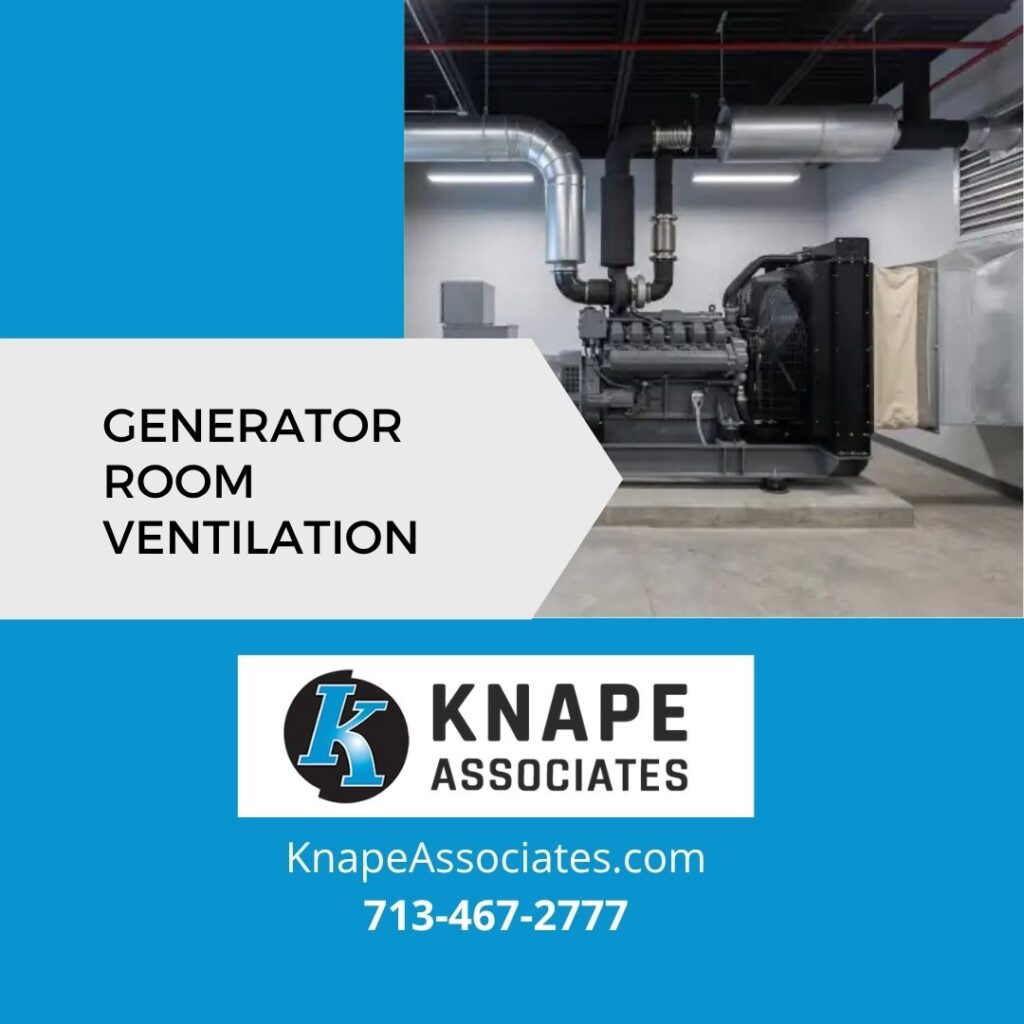
Generator room ventilation air is the airflow needed to hold the room’s temperature rise, plus the engine’s combustion air. Size the inlets and outlets for the larger of that total or the genset’s radiator cooling airflow. Where the radiator discharge is ducted straight outdoors, that air does not pass through the room outlet.
Two tests decide whether the room needs a fan of its own. The first is airflow. The second is restriction. A design has to pass both.
Where the air enters and leaves changes how much of it reaches the engine. Application guides apply a multiplier for each arrangement.
| Ventilation arrangement | Airflow multiplier |
|---|---|
| Preferred | 1 |
| Skid-mounted | 1 |
| Alternate | 1.5 |
| Least efficient | 2.5 |
A 2.5 multiplier can push a workable design past the restriction limit, so settle the opening locations early. The same method applies to a skid-mounted or containerized genset, where the enclosure is the room.
Sizing the louvers
Louvers are selected on free area velocity, not on face size. Free area is what stays open once the blades, frame and stiffeners are removed, and it sets both the pressure loss and the airflow at which the louver starts passing water. AMCA 500-L is the test method.
An acoustical louver passes the same air through a fraction of that open area. Matching a drainable louver’s airflow takes about twice the face area at eight inches deep, and more than three times at twelve inches.
So noise control is not a finish item. The louver choice changes the opening size and the pressure budget, and it can decide whether the room needs a fan. Send us the airflow and the opening you have, and we will tell you which way it goes.
Common questions
How do I calculate the ventilation air requirement for a generator room?
Generator room ventilation air is the airflow needed to hold the room's temperature rise, plus the engine's combustion air. Combustion air for a diesel engine runs about 2.5 cfm per brake horsepower. Both figures, and the radiator cooling airflow, come from the genset manufacturer's published application data.
Does a generator room need a separate ventilation fan?
A separate ventilation fan is needed only when the required ventilation airflow exceeds the genset's radiator cooling airflow, and the fan then makes up the difference. Restriction is a second limit. Published examples cap total path restriction near 0.50 in w.g., and one engine manufacturer recommends 0.25 in w.g. or lower.
How much ventilation does a generator need?
Published guidance puts a normal engine room temperature rise at 15 to 22.5 degrees Fahrenheit, and keeps the room below 120 degrees Fahrenheit. The airflow needed to hold that range depends on the heat the genset emits and on how the intake and discharge openings are arranged.
How do I size a generator room intake louver?
Intake louvers are sized on free area velocity rather than face size, because free area sets the pressure loss and the point at which water starts passing through. Drainable louvers publish about 50 percent free area, with water penetration beginning near 1,000 to 1,250 fpm under AMCA 500-L.
Do acoustical louvers change the ventilation design?
Acoustical louvers change the design because they publish roughly 15 to 25 percent free area, against about 50 percent for a drainable louver. Matching the same airflow takes about twice the face area at eight inches deep, and more than three times at twelve inches.
Related products
- UL listed fire dampers — where intake or discharge ducts pass through the room’s rated walls
- Fire smoke dampers — rated penetrations that also carry a smoke control requirement
- Backdraft dampers — stop reverse flow through the discharge opening when the genset is off
- Tube axial fans — ducted supply or exhaust where the radiator fan cannot carry the room
- Bifurcated fans — motor sits outside the airstream, for hot discharge air
- E-house and substation ventilation — the same equipment set for switchgear and control buildings