Tunnel Ventilation Fans
Tunnel ventilation fans clear smoke and exhaust fumes from road tunnels, metro and subway lines, and enclosed parking garages. Each application needs different thrust, a different temperature rating, and a different fire code. Spec the wrong fan and you fail a commissioning test or a fire rating.
Knape Associates supplies tunnel ventilation fans for all three applications from more than 30 manufacturer lines.
You get jet fans, main axial fans, and fire-rated dampers on one purchase order, from one point of contact.
When one manufacturer’s lead time stretches to 14 weeks, we pull equivalent equipment from another line without touching your spec. Your schedule holds.
Have questions? Need a fan quote?
Tunnel Ventilation Equipment
| Equipment Type | Application | Key Specs | Compliance |
|---|---|---|---|
| Unidirectional Jet Fans | Road tunnels, longitudinal ventilation systems | Up to 3,100N thrust, 630–1,250mm diameter, discharge velocity 20–35 m/s | AMCA 250 |
| Reversible Jet Fans | Bi-directional tunnels, metro and subway systems | Up to 2,710N thrust, 630–1,250mm diameter, 300°C/2h emergency rating | NFPA 130 |
| Parking Garage Jet Fans | Enclosed parking garages, impulse ventilation | 20–89N thrust, 315–630mm diameter, axial and centrifugal configurations | cULus 705, ASHRAE 62.1 |
| Main Axial and Centrifugal Fans | Ventilation shafts, transverse and semi-transverse systems | Up to 120,000 CFM, 630–1,600mm diameter, 400°C/2h fire rating available | AMCA 210, NFPA 502 |
| Tunnel Fire and Smoke Dampers | Transverse smoke control, fire zone isolation | 400°C/2h, bi-directional, tested to millions of pressure reversals | UL 555, NFPA 130/502 |
| Explosion-Proof Actuators | Damper and fan control in hazardous tunnel environments | Rated for Class I Division 1 and 2 classified areas | NEC Articles 500–505 |
Jet Fans for Road Tunnels and Metro Systems
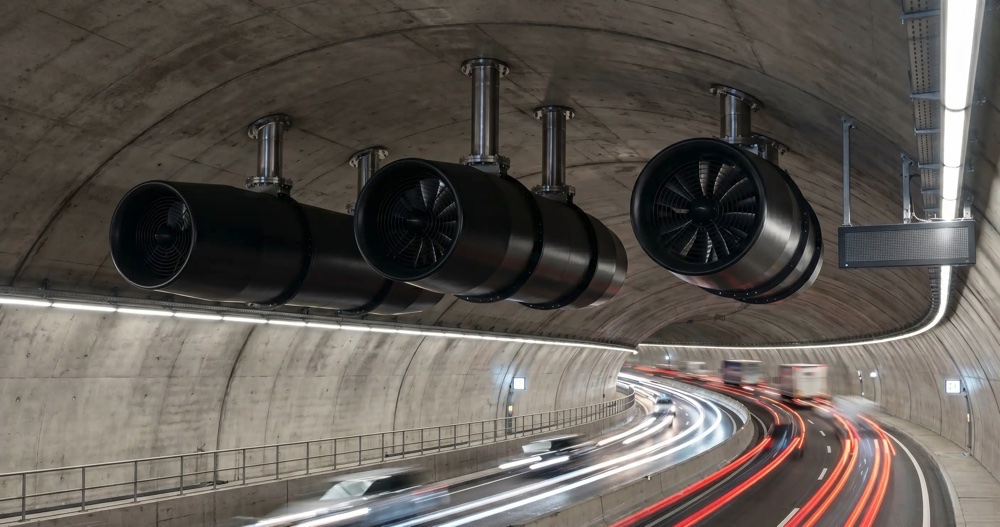
Jet fans move air through a tunnel without distribution ductwork. Each fan entrains the surrounding air and drives it toward exhaust points or portals, in banks spaced every 90 to 150 meters.
In a fire, they hold a critical velocity near 3 m/s to stop smoke from backlayering against the evacuation path.
Road Tunnel Jet Fans
Unidirectional thrust fans for highway and vehicular tunnels, up to 1,250mm diameter and 3,100N thrust. Discharge velocity runs 20 to 35 m/s.
Units are fire rated to 300°C for 2 hours, with 400°C available on request. Thrust is certified to AMCA 250.
Metro and Subway Tunnel Jet Fans
NFPA 130 requires transit-tunnel ventilation to run in both directions. Reversible fans deliver near-equal forward and reverse thrust up to 2,710N across 630 to 1,250mm diameters.
They absorb the pressure pulses from train movement and reverse airflow based on fire location and the evacuation route.
Parking Garage Exhaust Fans
We supply both kinds of parking garage exhaust fan, ducted units and ductless jet fans, and we stock both lines. So the fan we spec fits your structure and your CO load, not whatever one manufacturer wants to push.
Every selection meets the ASHRAE 62.1 garage exhaust rate of 0.75 CFM per square foot.
Parking Garage Jet Fans
Jet fans skip the ductwork completely, and that is where they earn their keep. Losing the ducts:
- Frees structural depth for lower floor-to-floor heights
- Cuts construction cost
- Opens up sprinkler and cable tray routing
Our units run 315 to 630mm at 20 to 89N thrust, each on a variable frequency drive so the garage ventilates only when CO and NO2 climb. That cuts fan runtime and energy cost against a fixed-speed system.
Gas Detection and Demand-Control Ventilation
We supply the controls side too, not just the fans. Sensors read CO and NO2, and the controller ramps the fans only when levels climb. The space stays within code, and the fans draw power only when they have to.
When the sensors, controller, and fans ship together, the sequence of operations is written to your equipment instead of reverse-engineered on site.
Related Products
- Bifurcated axial fans for high-temperature exhaust and smoke extraction
- Oil and gas HVAC equipment for refineries and petrochemical facilities
- Nuclear ventilation fans for safety-critical facility applications
- Control dampers for industrial airflow management systems
- Backward inclined fans for high-efficiency ventilation shafts
- Make-up air units for commercial and industrial facilities