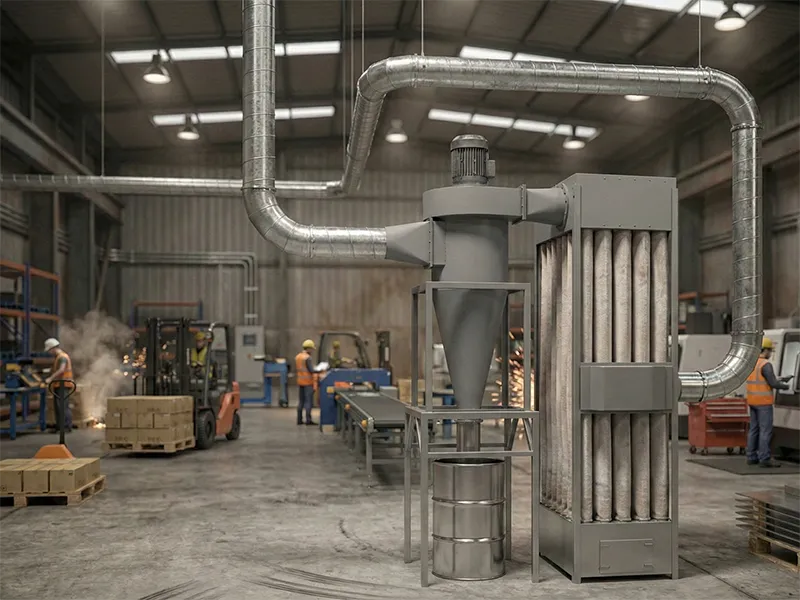
Industrial Cyclone Dust Collectors
Industrial cyclone dust collectors sized wrong cost $35,000 to $55,000 over five years. Undersized units spike energy consumption 33% while choking downstream filters. Oversized cyclone dust collectors drop from 90% design efficiency to below 69% in actual operation. Your facility pays for equipment that works on paper but fails air quality tests years ahead of schedule.
Knape Associates helps Texas and Gulf Coast facilities get the right cyclonic dust collector the first time.
We provide brand-neutral guidance across multiple cyclone dust collector manufacturers.
Your system is matched to actual particle size, airflow, and temperature requirements. You are not pushed toward one brand’s catalog.
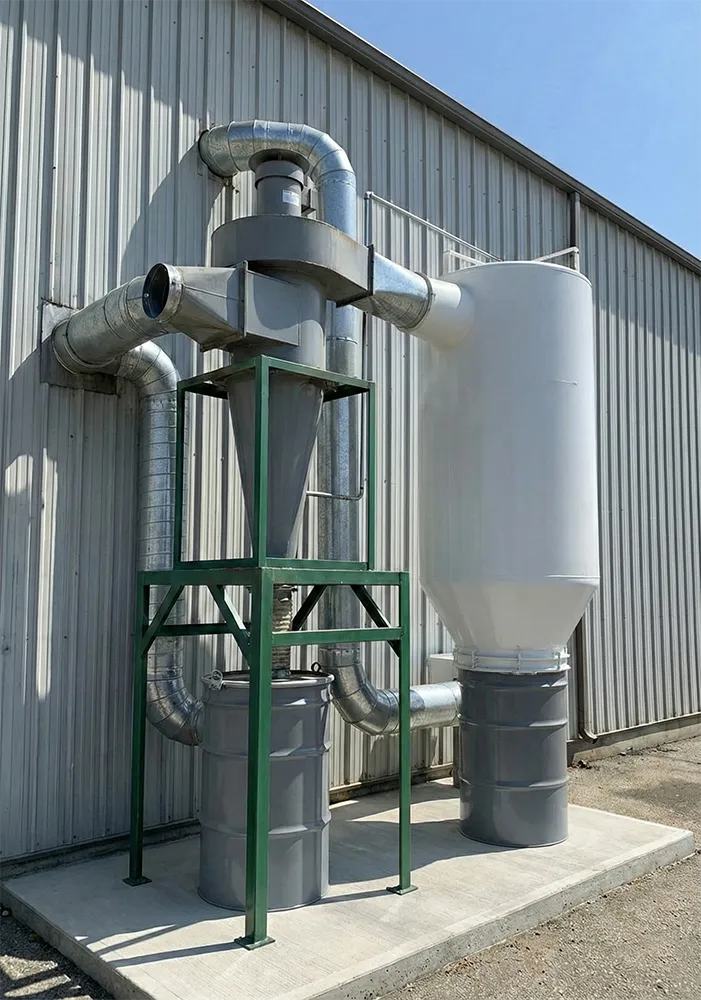
Our cyclone dust collection systems serve woodworking operations, grain handling facilities, metal fabrication shops, and foundries. Available configurations include standalone units for coarse dust, multi-cyclone setups for finer particles, and hybrid systems with secondary filtration. Each industrial cyclonic separator is sized to your process conditions and compliance requirements.
Have questions? Need a cyclone dust collection system?
Cyclone Dust Collector CFM Calculator
What type of dust are you collecting?
Different materials require different capture velocities. This determines your baseline CFM per pickup point.
How many pickup points will connect to this system?
Count each machine port or hood. A table saw with one port = 1 point. A CNC with two ports = 2 points.
How many points run at the same time?
If you have 6 machines but only 2 operators, you may only need CFM for 2 simultaneous points. This affects sizing significantly.
What is your longest duct run?
Measure from the farthest pickup point to where the collector will sit. Longer runs require more static pressure.
How many 90° elbows in your duct layout?
Each elbow adds resistance. Count bends in your longest run. Two 45° bends = one 90° elbow.
What main duct diameter are you planning?
If unsure, select “Help me determine” and we’ll recommend based on your CFM. Undersized ducts cause clogs and efficiency loss.
Key Takeaways
- Properly sized cyclone dust collectors hit 95%+ efficiency and pass compliance testing without expensive retrofits
- Wrong sizing costs $35,000 to $55,000 in added expenses or $30,000 to $50,000 in wasted capital
- Knape Associates provides brand-neutral guidance and tells you when a cyclone is not the right answer
What Wrong Sizing Costs Your Facility
Cyclone dust collector sizing errors fall into three categories. Each one drains money and efficiency in different ways.
| Impact Area | Undersized | Oversized | Wrong Temp Rating |
|---|---|---|---|
| Energy Costs | +30% consumption. $15-25K extra over 5 years. | Wasted fan power at low velocity. | Normal until seal failure. |
| Filter Life | Downstream filters clog. $2-4K/year extra maintenance. | Minimal impact. | Dust bypass destroys filters. $3-8K replacement. |
| Efficiency | System strains to meet airflow. Performance degrades faster. | Drops from 90% design to below 60% actual. Particles escape. | Seals fail in 6-18 months. Collection stops. |
| Compliance | Failed air quality tests. Retrofit required. | Potential emission gaps at reduced efficiency. | OSHA violations. $15-50K fines. |
| 5-Year Cost | $35-55K additional | $30-50K wasted capital | $40-150K+ |
Manufacturers publish spec sheets. They do not publish what happens when those specs do not match your facility. We see these failures across Texas operations every year.
When a Cyclone Alone Is Not Enough
Cyclones work best on big particles. Sawdust, wood chips, grain, large metal filings. Collection rates hit 95% or higher.
Fine dust is a different problem. The smaller the particle, the harder it is to capture.
Cyclones handle well:
- Woodworking dust
- Grain and feed dust
- Large metal chips and filings
Cyclones struggle with:
- Silica dust from cutting or grinding
- Fine metal grinding particles
- Pharmaceutical powders
If your operation generates fine dust, a cyclone alone will not keep you compliant. You need a hybrid system with secondary filtration. Costs more upfront. Keeps you out of OSHA’s $16,550 per violation range.
We will tell you if a cyclone is the wrong answer before you spend a dollar on the wrong system.
Cyclones handle well:
- Woodworking dust
- Grain and feed dust
- Large metal chips and filings
Cyclones struggle with:
- Silica dust from cutting or grinding
- Fine metal grinding particles
- Pharmaceutical powders
If your operation generates fine dust, a cyclone alone will not keep you compliant. You need a secondary filtration stage. A baghouse dust collector downstream of the cyclone captures particles the cyclone misses, removing up to 99.9% of fine particulate. Costs more upfront. Keeps you out of OSHA’s $16,550 per violation range.
Manufacturers sell cyclones. They will not tell you when a cyclone is the wrong answer. We will.