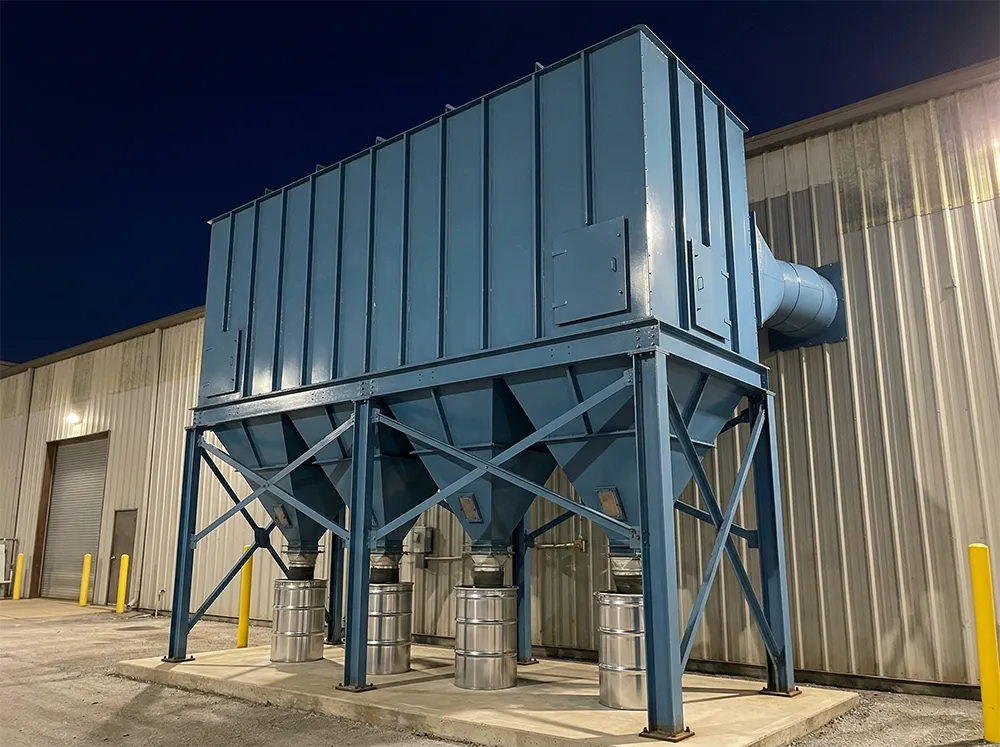
Industrial Baghouse Dust Collectors
Your baghouse filter bags should last one to three years. If you are replacing them every few months, the problem is not the bags. It is the specification behind them.
Wrong air-to-cloth ratio. Wrong filter media for your dust temperature or chemistry. Missing combustible dust analysis. Any one of these drives premature failure, unplanned shutdowns, and regulatory exposure you did not budget for.
OSHA penalties for dust collection violations reach $16,550 per serious citation and $165,514 for willful or repeated violations. Average manufacturing downtime runs $260,000 per hour. A misspecified baghouse does not just underperform. It compounds cost every shift it runs.
We compare pulse-jet, reverse air, and shaker baghouses from multiple manufacturers and match the right type and filter media to your dust, your temperature, and your compliance requirements.
You get one quote with multiple options clearly compared.
Have questions? Need a baghouse dust collector quote?
| Cleaning Method | Air-to-Cloth Ratio | CFM Range | Compressed Air | Best Applications | Relative Footprint |
|---|---|---|---|---|---|
| Pulse-jet | 5:1 to 15:1 | 1,000 to 100,000+ | Yes | Cement, metals, mining, general industrial. Most common for new installations. | Compact |
| Shaker | 2:1 to 6:1 | 300 to 7,000 | No | Woodworking, plastics, pharmaceuticals, food processing. Lower operating cost. | Medium |
| Reverse air | 1:1 to 4:1 | 10,000 to 100,000+ | No | Large high-temperature applications. Power generation, kilns, smelting. | Large |
Pulse-jet baghouses dominate new installations because they clean online and fit into smaller housings. Shaker types run without compressed air, which cuts operating cost for facilities that do not need high-volume capacity. Reverse air units handle very large airflows and high-temperature exhaust where other cleaning methods fall short.
For facilities with heavy incoming dust loads, a cyclone dust collector upstream of the baghouse removes 80 to 90 percent of coarse particles before they reach the filter bags. This two-stage approach extends bag life, reduces cleaning frequency, and lowers compressed air consumption in pulse-jet systems.
Selecting the right cleaning method depends on your dust characteristics, airflow volume, available floor space, and whether compressed air is readily available. We size systems from a few hundred CFM for single-machine pickup to 100,000+ CFM for central plant collection using industrial fans and blowers matched to your duct layout and pressure requirements.
Avoid the Specification Mistakes That Shorten Filter Life
Most baghouse problems trace back to four specification errors. All four are preventable at the design stage.
Air-to-cloth ratio errors are the most common. Undersized filter area forces high filtration velocity, rapid pressure drop buildup, and chronic bag failures from abrasion and excessive pulsing. Oversized systems waste capital. In pulse-jet units, over-cleaning at low differential pressure wastes compressed air and accelerates bag fatigue.
Wrong filter media for your operating conditions is the second. Standard polyester felt fails above 275 degrees F. Hygroscopic dust absorbs moisture and swells into a sticky cake that will not release during cleaning. Abrasive particles shred media that lacks the right fiber construction. Each dust type requires a specific media match.
| Filter Media | Max Continuous Temp | Best For |
|---|---|---|
| Polyester felt | 275 °F | General industrial, cement, grain |
| Aramid (Nomex) | 400 °F | Asphalt, metal smelting, high-heat exhaust |
| PPS (Ryton) | 375 °F | Coal boilers, incineration, acid gas environments |
| Fiberglass | 500 °F | Power generation, kilns, high-temperature processes |
| PTFE membrane | 500 °F | Sub-micron filtration, chemical resistance |
Third, facilities handling combustible dust that skip the NFPA 652 Dust Hazard Analysis create explosion risk and regulatory exposure. Combustible dust baghouses require deflagration venting or suppression, explosion isolation valves, rotary airlocks, and spark detection. The wrong equipment makes passing a DHA difficult or impossible.
Fourth, inadequate hopper discharge design allows dust buildup that abrades bag bottoms and causes re-entrainment. Rotary valves, double-dump valves, and proper hopper geometry prevent this. We evaluate all four specification areas before recommending a system.
Why a Multi-Manufacturer Distributor Instead of a Single-Brand Supplier
Single-brand suppliers sell what they manufacture. If their baghouse does not fit your application, you get the closest available option instead of the right one.
We compare pulse-jet, reverse air, and shaker baghouses across manufacturers. If a $15,000 shaker system with no compressed air requirement solves your problem, we will not push a $60,000 pulse-jet unit. If your dust is combustible, we specify the explosion protection and isolation dampers the system requires, not just the collector.
Our engineering team handles CFM sizing, duct design, filter media selection, and NFPA 652 compliance support. You receive one purchase order, one point of contact, and a system matched to your dust, your facility, and your budget. Not someone else’s catalog.
Related Products
- Axial fans for dust collection system air movement
- Centrifugal blower fans for high-pressure dust collection ductwork
- Explosion-proof heaters for facilities handling combustible dust
- VFD controlled fans for variable-load dust collection systems
- Industrial louvers and dampers for system air control
- Explosion-proof actuators for hazardous dust environments